If you run a small business in Dubai and started managing your own Instagram or Facebook page with real energy, only to watch the posting slow down a few months later, you are not the exception. You are the pattern. This happens to almost every small business owner in Dubai who tries to run social media themselves alongside actually running the business. It is not a discipline problem or a sign that you are bad at marketing. It is a predictable cycle, and once you understand exactly how it works, you can either fix it or make an informed decision to hand it off before it costs you more leads.
This guide walks through the real, observable pattern step by step — what happens in week one, what happens by month two, and what the page usually looks like by month three. Then it covers what the actual cost of that pattern is, even though it never shows up as a line item anywhere, and what the realistic paths forward look like.
"It is never that business owners in Dubai do not care about their page. It is that running a business and running a page at the same time eventually breaks, because only one of them can be the priority on a busy day."
Week One: The Motivated Start
Almost every small business in Dubai starts the same way. The owner, or someone on the team, decides social media needs attention, downloads Canva, picks a consistent color scheme, and commits to posting daily or every other day. The first week or two genuinely looks good. Posts go up on schedule, captions are thoughtful, and there is a real sense of momentum. This is the phase where owners tell themselves "this is manageable, I can keep this up."
The problem is not the intention in week one. The problem is that week one happens during a moment when the business allowed extra time for this new task, which is rarely the normal state of running a business in Dubai's competitive small business environment.
Month One: The First Gaps Appear
By the second or third week, something predictable happens. A supplier issue needs attention. A big client call runs long. Inventory needs counting. Whatever the specific interruption is, the pattern is the same: something that feels more urgent than a social media post takes priority, and a day is skipped. Then two days. The owner tells themselves they will catch up over the weekend, and sometimes they do, posting three things at once to make up for the gap.
This catch-up posting actually works against the page. Platforms respond better to a steady, spaced-out rhythm than to a burst of three posts in one day followed by silence. But at this stage, the business owner does not know this, and simply feels relieved to have "caught up," not realizing the pattern of gaps has already started.
Month Two: Engagement Starts Dropping, and So Does Motivation
This is the stage where the cycle becomes self-reinforcing. Because posting has become inconsistent, the page's reach starts dropping — fewer people see each post, fewer likes and comments come in. The business owner, now checking the numbers and seeing lower engagement than the enthusiastic first two weeks, starts to feel like the effort is not paying off. This is a completely understandable reaction, but it is based on a misunderstanding. The drop in engagement is not because the content got worse. It is because the inconsistency itself is being read by the platform's algorithm as a signal that this account is less active, and less active accounts get shown to fewer people.
Once motivation drops because the numbers look discouraging, posting frequency drops further, which drops engagement further, which drops motivation further. This is the exact loop that defines month two for almost every self-managed small business page in Dubai.
Month Three: The Page Goes Quiet
By month three, the pattern usually reaches its natural end point. Posting has become occasional — once a week, sometimes less. The business owner still intends to "get back to it properly soon," but daily operations have fully absorbed the time that was originally set aside for content. The page now sits there, technically active but functionally abandoned, with a last post date that a potential customer checking the account can see immediately.
This is the exact moment that costs the business real money, even though nothing about it looks like a financial loss on paper.
The Real Cost of a Quiet Page — What Actually Happens to Potential Customers
In Dubai's market, a potential customer almost always checks a business's Instagram or Facebook page before calling, messaging, or visiting, especially for service businesses like clinics, salons, restaurants, and retail. When that customer lands on a page where the last post is from six or eight weeks ago, it sends a specific, damaging signal: this business might not be very active right now, might be slow to respond, or might not be worth the risk compared to a competitor whose page looks alive and current.
This is not a hypothetical concern. It is one of the most consistent reasons potential customers in Dubai choose one business over another when the actual product or service on offer is similar. A dead page quietly costs leads every single day, without ever showing up as a specific number the business owner can point to and say "this is what it cost me."
Why This Happens Even to Genuinely Organized Business Owners
It is tempting to think this pattern only happens to disorganized people, but that is not accurate. It happens to careful, hard-working business owners just as often, because the underlying issue is not personal discipline. It is that social media management requires a specific, protected block of time every single week — planning, designing, writing, scheduling — and very few small business owners in Dubai have a role that allows for a protected weekly block that nothing else is allowed to interrupt. Running a business means the next fire is always more urgent than a content calendar, and that will always be true, no matter how organized someone is.
The Three Realistic Paths Forward
Once a business recognizes it is somewhere in this cycle, there are three realistic options, and being honest about which one actually fits matters more than picking the one that sounds best.
The first option is trying again with better systems — batching content one day a month, using a scheduling tool so posts go out automatically instead of requiring daily manual action. This can work for a business owner who genuinely can protect one focused day a month, but it requires real commitment to that one day being untouchable.
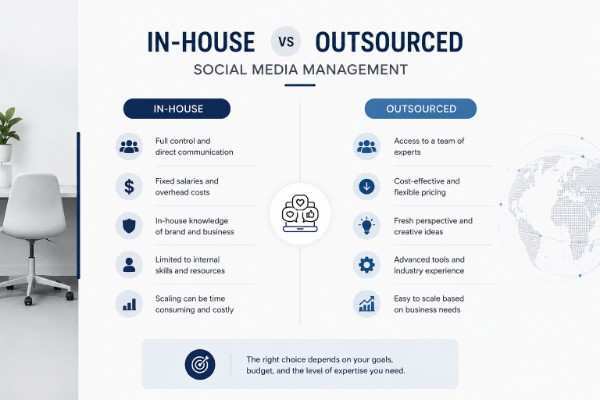
The second option is hiring a part-time or junior in-house person specifically for this task. This solves the time problem but introduces the coverage problem covered in detail in our guide on in-house versus outsourced social media management — one person still means the page goes quiet if that person is sick or leaves.
The third option is outsourcing to a small agency built for exactly this size of business. This removes the time burden from the owner entirely and replaces the single point of failure with a small team, at a flat monthly cost that is usually more predictable than the hidden cost of a quiet page.
What to Actually Look For If You Decide to Outsource
If outsourcing is the direction that makes sense, the decision does not end there — not every agency delivers the same value for the same price. Look for one that shows you real, current examples of pages they manage right now, not old portfolio pieces. Ask exactly how many posts, stories, and Reels are included each month, in writing, before signing anything. Ask how comments and messages are handled outside business hours, since a slow reply on a page that finally looks active again still loses the sale if nobody answers the DM. Our guide on choosing a digital marketing agency covers this decision in more detail.
The Dubai SME Social Media Cycle — Recognize It Early
- Week 1-2: strong motivated start, consistent posting
- Month 1: first gaps appear as daily operations take priority
- Month 2: inconsistent posting lowers reach, which lowers motivation further
- Month 3: page goes mostly quiet, still technically active but functionally abandoned
- A quiet page signals inactivity to potential customers checking before they buy
- The fix is either protected weekly time, an in-house hire, or outsourcing to a small team
Real Example: A Dubai Boutique's Page Before and After the Fix
What happened when a small fashion boutique in Dubai recognized the pattern at month four and outsourced.
A boutique clothing store in Dubai had posted actively for six weeks after opening, then slowed to roughly two posts a month by month four, matching the exact pattern described above. After switching to an outsourced growth package, posting returned to a consistent schedule within the first two weeks.
| Metric | Month 4 (Self-Managed) | Month 6 (Outsourced) |
|---|---|---|
| Posts per month | 2 | 18 |
| Profile visits per month | 340 | 1,150 |
| DM inquiries per month | 6 | 27 |
Frequently Asked Questions — Dubai SME Social Media
Why do small businesses in Dubai stop posting on social media after a few months?
Most business owners in Dubai start out excited and post consistently for a few weeks, but as daily operations pick up, social media becomes the first task pushed aside because it does not feel as urgent as customer orders or supplier calls. Once posting becomes inconsistent, engagement drops, which removes the motivation to keep going, and the page eventually goes quiet.
How long can a business page in Dubai go inactive before it hurts growth?
Even a gap of five to seven days without posting can noticeably reduce how many people see your next post, because platforms treat inactivity as a signal to deprioritize an account. A gap of several weeks or months usually means starting to rebuild reach almost from scratch.
What is the real cost of a business owner managing their own social media in Dubai?
The direct cost looks like zero since no one is being paid extra, but the real cost is the owner's time taken away from sales, operations, or client work, plus the lost leads from a page that looks inactive or unprofessional to potential customers checking it before making a decision.
What should a Dubai small business do instead of managing social media themselves?
Once the pattern of inconsistent posting starts repeating for more than one or two months, most businesses are better off handing the task to a freelancer or a small agency package built for their size and budget, rather than continuing to attempt it themselves in gaps between other work.